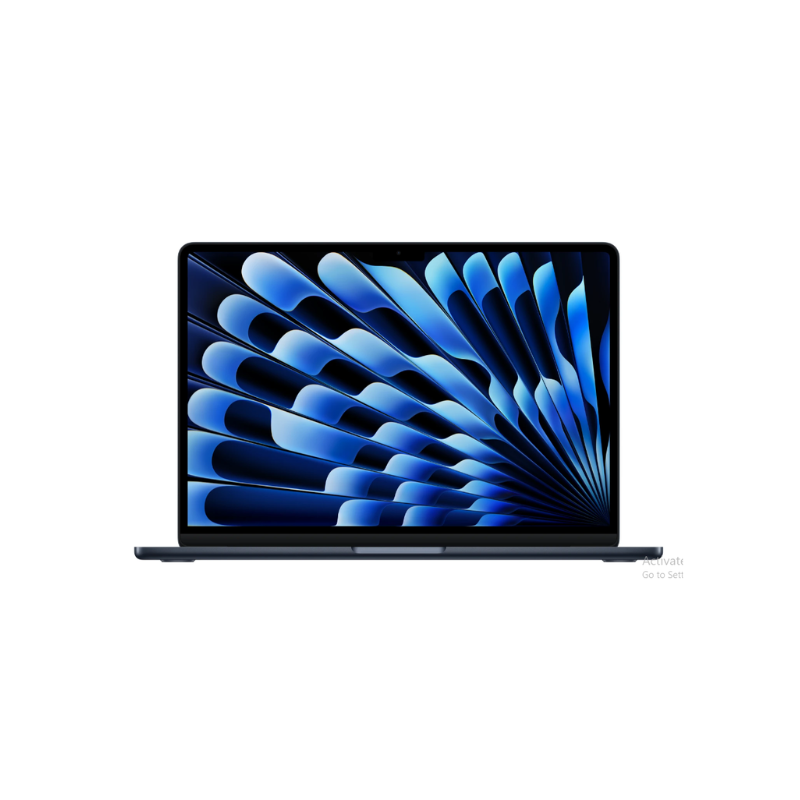
13-inch MacBook Air Apple M4 chip with 10-core CPU and 10-core GPU
Available in stock
The Apple MacBook Air M4 is basically built for people who want a lightweight premium laptop that feels fast all the time without carrying around a heavy workstation. The biggest strength here is not raw benchmark numbers — it’s efficiency. The M4 chip delivers strong performance while keeping the laptop fanless, silent, cool, and power-efficient. That combination is why the MacBook Air dominates the premium ultrabook category despite having fewer ports and less upgrade flexibility than many Windows laptops.
The 13.6-inch Liquid Retina display is sharp, color-accurate, and bright enough for content work, entertainment, and long daily usage. The aluminum build quality is still ahead of most Windows laptops in this weight category, and at only 1.24 kg, portability is one of its strongest selling points. Battery life is another major advantage. Realistically, for web browsing, meetings, writing, content management, social media work, and moderate editing, this machine can comfortably last an entire workday without needing constant charging.
Performance-wise, the M4 chip is extremely efficient for multitasking, video editing, content creation, coding, student work, and productivity tasks. Features like hardware ray tracing, AV1 decoding, ProRes engines, and the 16-core Neural Engine make it much more future-ready for AI-assisted workflows and creative applications than older Air models. Even though it’s called an “Air,” it’s now powerful enough for fairly serious workloads like 4K video editing, Photoshop, light motion graphics, and running multiple heavy apps simultaneously.
But there are important realities buyers ignore because of Apple marketing. The base 256GB SSD is restrictive in 2026 if you work with videos, large files, or creative assets. Apple charges aggressively for RAM and storage upgrades, and since memory is unified and non-upgradable, buying the wrong configuration becomes an expensive mistake later. Also, the 60Hz display is still disappointing at this price when many cheaper laptops offer higher refresh rates.
Another thing people misunderstand: the Air is powerful, but it is not designed for sustained heavy rendering or high-end gaming sessions like a MacBook Pro. Since it has no fan, thermal throttling will happen under prolonged heavy loads. For normal users that’s irrelevant, but for professional 3D rendering, advanced motion graphics, or nonstop export workloads, the Pro models still make more sense.
For students, social media managers, office professionals, creators, and users who value portability, battery life, silent operation, and long-term smoothness, this is one of the best balanced premium laptops available right now. But if someone buys it mainly for gaming, upgrade flexibility, or maximum performance-per-rupee, they’re paying heavily for ecosystem and design rather than pure hardware value.